Grupo de Investigación en Tecnología Educativa 2017 – #EHTC1617

I had a wonderful opportunity to make a (virtual) visit to Universidad de Murcia last week to speak with the students in . This was my second visit and it was wonderful to connect with Dr. Paz Prendes and her students again! I will be continuing the conversation over the next few weeks in their Moodle course and of course – on twitter!


More Lessons Learned: Digital Footprints, Creative Commons & Good Tagging Practice

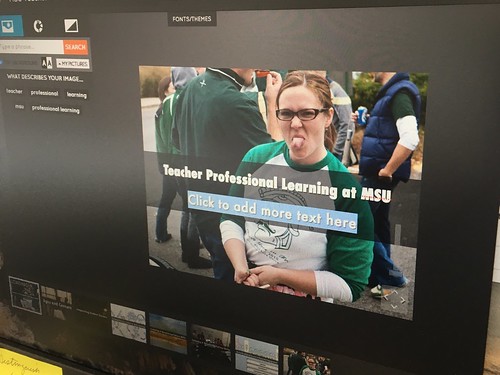
A lesson in tagging & Creative CommonsErik stopped me this morning and said “hey, did you know there is a picture of you sticking your tongue out when you search for “MSU” on Haiku Deck.” No, no I did not know this.

Sure enough, Haiku pulls from Creative Commons images on Flickr. I have been using Flickr for over 10 years and I’m a big supporter and contributor to the Creative Commons (it’s one of the main reasons I use Flickr for my social photo sharing!) I frequently tailgate, and, post pictures from MSU tailgates.  Thus, a few years back I posted this picture (and a few others) of the fun, with the tags MSU, Tailgate, spartans, gogreen.

Fast forward 7 years and Erik is searching for a nice picture of MSU for his presentation, and here I am, sticking my tongue out at him and who knows how many other Haiku/CC users.  It’s not the worst thing that could happen in terms of a digital footprint, but, it did make me take another look at my Flickr tags.  It also makes me think about Flickr’s auto-tagging feature and how they might influence my photo showing up on a CC search.  Just spent some time going through my Flickr tags and cleaning things up a bit. Thanks Erik!

Lessons Learned from the #MSUrbanSTEM Build-a-Boat Quickfire

I was fortunate to have the opportunity to facilitate a QuickFire challenge with the MSUrbanSTEM fellows last weekend. It has been a quite a while since I’ve facilitated a QuickFire challenge (thought it has been amazing to watch them spread!) and it was clear I was slightly out of practice. Things didn’t go completely off the rails, but I did want to take a moment to reflect here, just in case anyone wanted to take this idea and run with it in another context.

My challenge:

Our MSUrbanSTEM fellows have been reading Rocking the Boat and we needed an activity to bridge a discussion of Rocking the Boat with another discussion focused on teaching in urban contexts.  One thing I have learned in coming up with QuickFire challenges is that there is no need to reinvent the wheel – a lot of great content exists in the world – so I searched for an activity and came across this “Build a Boat” activity from Elmer’s Glue Teacher’s Club.

On the surface it may seem like we’re “just” building a boat to float on water and carry pennies (which, has lots of great connections to science and physics) but – the way the challenge had the added twist of calculating the cost of the materials made it extra intriguing.  Not only did this activity encapsulate all the individual letters in STEM, it had the interdisciplinary and interconnected components I seek out when looking for a QuickFire. For example, we could change the evaluation measures (what makes a “good” boat) which allowed the connection not only to the Rocking the Boat book but to our conversation about teaching in urban contexts.

To start, I edited the challenge a bit to resonate with our class:

Build a boat challenge instructions

The activity was relatively inexpensive to pull together (this was for 50 people, 10 teams of 5):

  • Popsicle Sticks (200) = 4.99
  • Roll of Aluminum Foil = 3.99
  • Straws (100) = .99
  • 12 School Glue Pens = 10.49
  • Corks (30) = 11.40 (purchased at hardware store, though probably could have found these cheaper at homebrew store)
  • Masking Tape = 5.00
  • 6 rolls of pennies = 3.00
  • Total = 39.86

You could easily swap out items to make things a little less expensive, you could leave out the corks, change masking for scotch tape, etc.  I repurposed two clear plastic containers from home to represent Lake Michigan – and we’re good to go, right?

Not quite – a QuickFire requires intense attention to detail. How will the groups be divided? (We had 10 teams of 5, split into our two classrooms.) What if we run out of materials? (I put in some material constraints.)  What if their boats are bigger than the “lake”? (They were shown the lake so they knew it had to fit.) I thought through all of these logistics and put constraints in place to account for everything that could happen – so I thought.

On the day of class, we decided to change the evaluation measure to “The boat which has the least cost per teacher (penny) is the winner.” We don’t have a printer in class and print our materials ahead of time, so, we dutifully crossed our our original evaluation measure and wrote in the new one, no big deal.

Teams were given 10 minutes to create the boats – which, after an initial panic moment (which is intentional in a QuickFire) teams got to work and created some amazing boats.

Here’s where the challenge needs revision for the next iteration. I should not have left the pennies out as teams started opening the rolls and testing the boats as they were developing.  Testing is ok, but, I hadn’t planned for it (and was afraid of losing track of all the pennies.) Next time, I will hide the pennies. Also, a few groups stacked the entire rolls on the boats when they were testing and they subsequently got wet. This made me panic, did I have enough pennies?? I honestly thought I had plenty of pennies….

Additionally, I didn’t take into account that it would take quite a while for me to float 10 boats and stack/measure pennies on the boats.  Our instructional days are tightly timed, so, I had to pivot and the team was gracious enough to move time around in the afternoon – so we delayed the “reveal” to the end of the day.  This was a let-down as a QuickFire usually is a contained experience. Delaying the conclusion takes away from the in-the-moment excitement.

A few hours later during some in-between time in the instructional day we carefully arranged the boats in front of the lecture hall with the two “lakes” ready to float the boats.  With the time re-arrangement, I would have about 5 minutes to float the boats and stack pennies – in front of everyone. Luckily I had the boat cost tallies up on the board and a colleague to help with the math as I would announce how many pennies each boat would hold and she would calculate the cost/penny on each boat. This is where (to me) everything really started to fall apart.  Some boats could hold 3 entire rolls of pennies (I did not think this would happen) and I panicked a bit and started with the boats that would hold the most.  I also did not take into account that taking the boats in and out of the water would be — messy.  As you can see in the pictures and video below, I did not have the most calm/serene look on my face! Unfortunately, it was a bit rushed – but – we did the best we could and declared a winner based upon the calculations.  Because of the rush – we didn’t have time to deconstruct/discuss how people made the boats and how we could have changed our evaluation metrics.

If I had to do it all over again, it would need a minimum of 45 minutes from start to finish.  I don’t think splitting into two periods (construction and floating) was necessarily a bad idea – especially since it gave time for glue to dry. If we went with this configuration I would budget 20 minutes for construction and 30 minutes for floating/calculating/discussing.

So, some big lessons (re)learned:

  • things always take longer than you think they will
  • when you’re out of practice, you forget how important every, single, detail is to orchestrate a smooth experience
  • don’t panic
  • a trial run would have revealed a lot of the flaws in my plan.

In reflecting, I didn’t feel it was all a disaster as several teachers commented to me that they found the activity worthwhile and were interested in taking this challenge to their class (thus the motivation to write this post so others can learn from my mistakes!)

Recap of visit to @edtechne & @StAngelasSligo to share #MSUHub stories

Last week I was very lucky to visit Galway and the School of Education at NUI Galway and St. Angela’s College, Sligo (via zoom link!) I was asked to talk about the emerging work of the Hub, specifically our adaptation of Scrum to guide and share our project work.  Below you will find the slides & abstract from the talk.  It was absolutely wonderful to reconnect with all of my dear friends in Galway and to meet new colleagues in Sligo. I sincerely appreciated the invitation and I hope we can continue the dialogue via twitter – or another Zoom session!

Abstract

One year ago, Michigan State University (MSU) started a new campus initiative: The Hub for Innovation in Teaching & Learning (“The Hub”). The Hub’s mission is to “facilitate the passion and inventiveness of students, faculty, staff, and stakeholders both inside and outside of MSU to create, identify, and accelerate new ways to collaborate, learn, research, and deliver instruction.” While the core staff of The Hub is quite small, many on campus are working with and through the Hub. To facilitate this campus change, the Hub leadership team has anchored much of its “getting started” work and processes to sound design theories and processes. One technique which has proven successful in sharing our work openly and strategically is “scrum” – a framework for project development. In this session, I will share the scrum process along with other lessons learned from our first year as a campus entity.


New Publication: Chapter in Handbook on Digital Learning for K-12 Schools

It’s always fun to see your name and hard work in print! Sincerely thankful to Drs. Ann Marcus-Quinn & Tríona Hourigan at the University of Limerick for the opportunity to contribute to the handbook and to my wonderful and amazing collaborators!

Heintz, A., Hagerman, M.S., Boltz, L.O., & Wolf, L.G. (2017). Teacher awarenesses and blended
instruction practices: Interview research with K-12 teachers. Handbook for Digital Learning in K-12 Schools. Springer.

Abstract

In our research, we talked to four early-career teachers who have adopted blended instruction practices for their classrooms. Through systems-based thinking that held in view awareness of self, learners, context, pedagogy, and interaction, these teachers established a blended classroom driven by a consistent vision and manifested through complex and diverse means.

For friends at MSU, here is the direct link to the eBook through the library:
http://link.springer.com.proxy1.cl.msu.edu/book/10.1007/978-3-319-33808-8

Online Presence and Public Scholarship Working Group Kick Off #MSUAAN

I’m excited to kick off a new initiative today: the Online Presence and Public Scholarship Working Group.  In my new role as an academic specialist in the Dean’s office in the College of Education (I’m still with the Hub, 25%, 75% College of Ed!) one of my charges is to: Develop capacity and community among faculty, students and staff around innovative practices in teaching and learning to support innovation and inclusivity in instruction and program development. So, this is the first of many opportunities.  (I’m also really excited that A Domain of One’s Own is a part of this initiative.)

The Working Group is kicking off (right now!) with Dean Chris Long’s workshop: Cultivating an Online Scholarly Presence. We will then follow up with weekly co-working sessions over the next 9 weeks to support faculty in the development of their online presence. The original call for participation is below – we have 21 faculty members who will be working with us – along with others who will informally drop in and out when their schedules allow. The underlying purposes here are to provide a safe, fun, intellectual and supportive space to grow and to evaluate this facilitation format as a sustainable model for professional development.

======

Original Call for Participation:

Dear colleagues, we invite your participation in our newly created Online Presence and Public Scholarship Working Group during Fall 2016. We will be accepting five faculty members from our college into the program who will then participate with colleagues from the Colleges of Natural Science and Education in a semester long program designed to help you plan (or revise) and implement a digital online presence and public scholarship routines, mindsets and workflows.

Online presence and public scholarship are ways to enhance your own research and reputation, along with that of the University.  While many workshops start with the “how to”, this program is designed to help you navigate challenging and nuanced questions like: Why should you have a digital presence? Who is interested in my work and scholarship?  How can this work be recognized professionally? Once we navigate these discussions we will move on to discovering which platform(s) match your goals. In addition, this experience will provide you with resources and collaborators to start your presence now and help evolve and sustain your presence into the future.

Topics

The program will cover a variety of topics associated with planning and developing your personal public scholarship strategy. We will start by focusing on your pathway to intellectual leadership in your field and what the components of a successful strategy are, then moving into more of the detailed logistics of setting up digital tools and accounts to support the strategy you have developed. We welcome faculty at all stages of thinking about this work and will help ensure that each person is able to move forward with their own plans.

What is expected?

Fellows will be expected to attend two workshops over the course of the semester and 6 one-hour co-working sessions that will focus on a general topic and work strategy each week and provide an open dedicated forum for support. Fellows will also have the opportunity to attend other optional workshops, and will have access to one-on-one mentorship from the workshop facilitation team.

Applications are due by Friday, September 23 and we will be notifying participants early during the following week.

If you are unable to commit to the full time commitment of the fellows program, but are interested in starting to develop your online presence, please respond to this message and we will include you on an email list which details other learning opportunities.

Facilitators
This program is a collaboration between the Colleges of Arts and Letters, Education, and Natural Science, along with the Hub for Innovation in Teaching and Learning. Main facilitators for the program will be Drs. Leigh Graves Wolf (Education/MSU Hub), Scott Schopieray (Arts and Letters), and Stephen Thomas (Natural Science). We will also be joined by guest facilitators and faculty from across campus. In addition to the specific goal of mentoring faculty in their online presence goals, we are experimenting with new models for faculty development and support structures and will be gathering feedback on this mode and method of training and mentoring.

Is Educational Technology a Discipline? Let’s talk.

Yesterday this tweet:

Prompted this brief twitter conversation (click on the timestamp to see the conversation):

The title of the article begged the question – does this mean people do not see Educational Technology as a discipline?  I have a PhD with the words “Educational Technology” and for almost 10 years, I served as the co-director of the Master of Arts in Educational Technology program.

If you read the comments in the article (actually one time I will suggest reading comments!) you will see other people pointing this out as well. (Including a clarification from Eddie Maloney on how his opinions were represented and interpreted.) The voices on the panel are certainly not representative of the field – and many come from interdisciplinary or emerging fields.  This conflict/question has been brewing in my mind recently as I have been in conversations with, or have read pieces from, the User Experience (UX), Experience Architecture (XA), Human Computer Interaction (HCI), Instructional Technology, Information and Communications Technology (ICT), Digital Humanities (DH) fields.  While the article that prompted this post is one singular article, from a non-scholarly publication, I think this is an area worth exploring/defining/discussing at greater depth.  How are the disciplines I mentioned different? Similar? Where do they intersect? Where should they intersect? Are they co-opting or competing with each other, when they should be collaborating?

So, I want to think out loud with my smart friends (beyond 140 characters) – let’s start in the comments here and see where that takes us!


Update :

Thank you to Inese Berzina-Pitcher for this reference:

Sugimoto, C. R., & Weingart, S. (2015). The kaleidoscope of disciplinarity. Journal of Documentation, 71(4), 775-794. doi:10.1108/JD-06-2014-0082 (link works w/MSU log in)

The power of sharing & collaboration (again!)

Just (another) quick example of the power of sharing and collaboration.  I’m excited to be co-facilitating an Undergraduate Honors Research Seminar this fall with Jeff & Bill.  After all of my MAET years, I know how important day one, minute one are of class.  As I was thinking about first day activities (that do NOT involve reading the syllabus!!) I came across this post from Heather on Facebook:

Picture of chalkboard with post-it notes

I was immediately intrigued and the following dialogue ensued (I could summarize, but why not share!)

Facebook discussion

And, it’s as simple as that! Thank you Heather for sharing & for the inspiration!

#HSET16 Inaugural Huron Shores Educational Technology Conference Keynote

It was an honor to speak with educators today at the Huron Shores Educational Technology Conference. A big thanks to MAET grad Ashlie O’Connor for this opportunity! Ashlie and Meghan did a fabulous job organizing this incredible opportunity for educators in North East Michigan!

The slides from the keynote are embedded below w/embedded links and you can follow along with all of the tweets and resources shared by following #HSET16.

After the Post It Notes Are Gone – Thoughts on Design Thinking in Academia

Design thinking. Back end.At the end of one of the MSU Faculty Development seminars I facilitated back in March Dr. Chivukula made an observation in the Applying Design Thinking to Academic Plans workshop I was facilitating. He said/asked (as I recall) design thinking seems to have a place at the beginning of processes but, where does it fit long term? This is a question that has set in my mind almost every day now for the past 2 months – literally on my drive to or from work it will pop in my head, or, as we’re engaged in other Hub discussions or activities that involve design thinking. At the time, I think I said something to the effect of – yes, you’re right, but, my (lack of an) answer has always sat poorly with me. I didn’t like that I didn’t have a better answer and couldn’t articulate some of the tensions I myself was feeling around design thinking. I touched on this angst in the presentation – and at the end of the blog post reflection on the workshop I said:

“In sum, I don’t want people to walk away thinking that this is the only way that I work.  It’s a tool in my toolbox (or whatever metaphor you want to use) as a way to tackle wicked problems.”

Now, fast forward to a few weeks ago – on May 19th the Hub facilitated a Design Day which was the start of a 10 month iterative process of creating a new way to prepare veterinarians at Michigan State University.  We led participants through design thinking activities to elicit ideas and to raise questions about the process. But, then what? So many activities that involve design thinking, post-it notes and brainstorming seem to end in the room. It’s the process that is important — ok, but, a lot of data was generated and a lot of people took precious time off to contribute to the process. How can we honor the time that was dedicated and use the artifacts that were created to further the curriculum reinvention?

If we’re going to be successful at using design thinking in academic contexts, we (I) have to more clearly articulate and situate the strategies and frameworks we’re using within our academic contexts. So – in reflecting on ways not only to capture, but to analyse, synthesize and report we huddled as a team, transcribed post-it notes, created abstractions, performed some qualitative data analysis and created a this report for participants.

The abstractions in particular have received initial positive feedback. Caroline and Libby were tasked with taking the photograpped “maps” that participants had created and I asked them to create the most simple representation possible. (I highly encourage you to read Chapter 5 of Sparks of Genius (Root-Bernstein, 1999) for more insight into the creative act of abstraction.)

I hope that the report helps to provide a more solid footing and insight one way design thinking can not only be operationalized in the moment, but, as an artifact that can be embedded into a process over time. On a somewhat related tangent, we were very purposeful about counting our hours and time dedicated to the project (something that I rarely do) you can find the full detail in the end of the report but essentially it took 125 hours of preparation and 51 hours of analysis.

There is no single solution, no magic bullet to solving wicked problems.  Henriksen et al (2015) outline a rubric for creative work – one that is NEW: Novel, Effective, Whole.  One thing that I have noticed in working across all colleges on campus over the past few months, in so many different contexts is that by nature we tend to desire a solution.  Johansson‐Sköldberg et al (2013) provide a critical analysis of design thinking and I highly recommend taking the time to read this.  Design thinking is one way we can and will solve problems, but it certainly is not the only way.   Design thinking is not new, but, the combination (or bricolage) of the techniques we’re using to solve complex problems (I hope) is NEW (novel, effective & whole) to our unique context as a university.  It is then extremely important that we thoughtfully situate and articulate these processes to our peers here at MSU and as an organization (the Hub); to be clear and purposeful in the techniques, frameworks and processes we are our combining in our toolbox to do our work.

Now what? In having spent some time thinking this through (at least a little bit, and adding a bit of scholarship) I would like to link to Jeff’s post from a few days ago – The new (?) learning designer (engineer) which touches on the array of skill-sets needed to operate in the above context.  In my research for the Design Day report, I came across Wilson & Zamberlan’s 2015 piece: Design for an Unknown Future: Amplified Roles for Collaboration, New Design Knowledge, and Creativity. To me it is a thoughtful and clever articulation of the skills needed to engage in the wicked problem solving that we are doing.

So, where does this leave us? What are your thoughts, struggles, triumphs? Would love to hear your reactions and comments.


Wilson, S., & Zamberlan, L. (2015). Design for an Unknown Future: Amplified Roles for Collaboration, New Design Knowledge, and Creativity. Design Issues, 31(2), 3-15. doi:10.1162/DESI_a_00318.

Henriksen, D., Mishra, P. & Mehta, R. (2015). Novel, Effective, Whole: Toward a NEW Framework for Evaluations of Creative Products. Journal of Technology and Teacher Education, 23(3), 455-478. Chesapeake, VA: Society for Information Technology & Teacher Education.

Johansson‐Sköldberg, U., Woodilla, J., Çetinkaya, M., Gothenburg Research Institute (GRI), Faculty of Fine, Applied and Performing Arts, University of Gothenburg . Department of Business Administration. (2013). Design thinking: Past, present and possible futures. Creativity and Innovation Management, 22(2), 121-146. doi:10.1111/caim.12023

Root-Bernstein, R. S., & Root-Bernstein, M. (1999). Sparks of genius: The thirteen thinking tools of the world’s most creative people. Boston: Houghton Mifflin Co.