#LNDLCA Design Thinking in Classroom Contexts Webinar

I had a wonderful time this afternoon meeting with dedicated educators across Canada who are members of the #LNDLCA community. My dear friend Dr. Michelle Schira Hagerman extended the invitation as a part of her groundbreaking work leading the The Canadian Institute for Digital Literacies Learning.

Below are a few artifacts from the session (thanks for the tweet Michelle!) – I’ve embedded my slides and the original invitation to the webinar.  I look forward to continued conversations and connections via the #LNDLCA hashtag!


Slides

Invitation: Webinar with Dr. Leigh Graves Wolf

From Buzzwords, to Theory, to Practice: Design Thinking in Classroom Contexts

Dr. Leigh Graves Wolf is teacher-scholar and a Clinical Associate Professor in the Mary Lou Fulton Teachers College at Arizona State University. Leigh teaches with the Educational Leadership and Innovation EdD program and is a faculty fellow with the Office of Scholarship & Innovation. Her work centers around online education, K12 teacher professional development and relationships mediated by and with technology. She has worked across the educational spectrum from K12 to Higher to further and lifelong. She believes passionately in collaboration and community. Leigh shares her work at www.leighgraveswolf.com.

We invited Dr. Wolf to share her expertise with us because she is a creative, innovative teacher, scholar, and leader who, over the past decade, has leveraged design thinking frameworks to lead massive institutional change projects at the macro-level, and to create daily lessons for her own students at the micro-level. Leigh has offered to share her current thoughts about design thinking — which, despite being a bit of an educational buzzword — is worth understanding as a powerful framework for the design of theoretically and evidence-based classroom practices in every discipline.

This session will take place from 4PM to 5PM on Wednesday, November 28th, 2018. Please join us! The webinar will be hosted using Zoom.us. You can attend from the comfort of your home, on a laptop or via the Zoom app on your smartphone.


The Longview Grant: Global Education Micro Credential Pilot

One of the last projects I was working on at MSU has concluded – and I realized I never shared any updates/info on the grant! In May 2017, Margo Glew, Kyle Greenwalt and I were awarded a grant from the Longview Foundation titled: Digital Badging for Global Teacher Learning.  We proposed the following:

This proposal seeks to develop two learning modules for global educators, both inservice educators and preservice educators who have reached the field placement portion of their program. These modules will be available to teacher candidates and practicing teachers anywhere and will engage participants in two areas of global education practice: the first module (for elementary educators) will focus on developing competency in global project-based learning curriculum design, and the second (for secondary educators) on integrating global citizenship education into the teacher participant’s subject area. These modules will consist of a combination of online learning and collaboration, specific classroom projects, and preparation of curricular units and lessons.

The design of the learning modules will center around the development of competency in one area of global teaching (project based learning/global citizenship education) and not, as is common in other forms of professional learning, the completion of “seat time” at a workshop or presentation. In addition to receiving continuing education credits, teacher participants will, at the successful completion of the learning module, be recognized for their competency with a digital credential. This digital badge will be available for teachers and teacher candidates to display on their LinkedIn or other social media profiles to communicate their expertise in this area of global education. Teachers will also receive the badge in the form of a vinyl cling to display outside of their classroom door. The modules will be developed by a team of colleagues from Michigan State University’s nationally recognized teacher preparation program and K12 global educators and education leaders to meet the specific needs of practicing global educators and global educator teacher candidates. The purpose of the project is twofold: 1) we seek to develop and deliver two global education micro-credentials to practicing teachers and teacher candidates; 2) we seek to develop a framework for the learning pathway, technical infrastructure and administrative infrastructure for managing, reviewing and awarding digital badges for global education so that future credentials may be developed and implemented. It is our goal to ultimately develop and deliver a range of micro-credentials for a variety of competency areas for the global educator.

We partnered with Kelly Jacobs from the Lansing School District and Robert Lurie from Waverly High School.  I was responsible for the website and editing the podcasts (the teachers and Kyle/Margo created the content.) Here is the final result of our efforts (three modules!) which we used to run a pilot this fall:

http://gravesle.msu.domains/GlobalEd/

I had SO much fun editing the podcasts (it was great to get back to my audio production roots) and I learned a lot about publishing to iTunes!

The pilot has ended (thus, no more Michigan Continuing Education Credits) – but – you can still download all of the podcasts here on iTunes (or, directly download the mp3 files from the Microcredential Website.)

A Meta Reflection (and Thank You): Bell & Cronin’s #altc Presentation

I am writing this post as a resource for my TEL 713 – Advanced Qualitative Methods students, but, hope others will find it useful as well.

First, I want to share what a tremendous resource The Association for Learning Technology (ALT) is broadly. I am a member of ALT, and I am extremely thankful for their community, conferences and open access to conference content for those who cannot attend in person. Here is the archive from the 2018 Annual Conference which just wrapped up on September 13th. Several of the talks were streamed and are archived on the website for viewing. I also encourage you to take a look at the #altc hashtag for further conversations and resources.

Selfishly, the timing of  Drs. Frances Bell & Catherine Cronin’s ALT presentation: A personal, feminist and critical retrospective of Learning (and) Technology, 1994-2018  could not have been more perfect.  In TEL 713 (Advanced Qualitative Methods) we are approaching the modules on feminist and critical pedagogies. Here is the recording of Frances & Catherine’s session:


I am sharing this specific talk with my students for a few reasons –

First: I want to note that the session type is a: Work-in-progress report/experimental session.  So often we feel as we have to have something finished or complete before we share. Francis and Catherine are using the conference to share work in progress, and, to solicit feedback to improve their inquiry.

Second: I want to point out the references (with my meta commentary in italics after the reference.)

Cronin, C. (2017). Openness and praxis: Exploring the use of open educational practices in higher education. IRRODL, 18(5). http://dx.doi.org/10.19173/irrodl.v18i5.3096

TEL 713: Look at Dr. Cronin’s theoretical framework section as a mentor text for framing a study.

Noddings, N., & Enright, D.S. (1983). The promise of open education. Theory Into Practice, 22(3), 182-189. https://doi.org/10.1080/00405848309543059  (ASU Library Link to full text)

TEL 713: Dr. Nel Noddings is a feminist scholar and philosopher.

Watters, A. (2015, February 19). The history of the future of education. hackeducation.com [blog]. Retrieved March 23, 2018, from: http://hackeducation.com/2015/02/19/the-history-of-the-future-of-education

TEL 713: Audrey Watters is an education writer and independent scholar who writes with a critical stance towards education and technology.

Third and finally: This is an excellent example of a qualitative study in a community of practice (or sphere of influence.) You’ll note that Frances & Catherine have coded and analyzed the themes of the ALT conferences over the past 25 years through a feminist & critical lens.  As you’re looking for models and mentor texts, this is one to add to your list of supports.

Thank you Drs. Bell & Cronin for sharing your work so openly and for allowing us to learn from your inquiry.

SITE 2018 The Quickfire Challenge Roundtable: How to fail fast & learn while having fun

We (Candace & Leigh) are honored to present at SITE 2018. This blog post will serve as our guide and “handout” for our roundtable session.

Inspired by reality TV cooking shows, the “Quickfire Challenge” is an educational tool created as an activity in the Master of Arts in Educational Technology (MAET) program at Michigan State University (Wolf, 2009). Over the past 8 years the Quickfire Challenge has been a core of the student learning experience. Having theoretical underpinnings in Mezirow’s Transformative Learning Theory (1991), the Quickfire Challenge is structured to create a (gently) disorienting experience which challenges traditional forms of professional development models. Quickfire Challenges are carefully crafted to impose time constraints, give specific, yet vague directions, embed tangible outcomes, all the while keeping learning at the core. By experiencing failure (and success) in this format, participants begin to rediscover the joy and creativity necessary to spark engagement in curriculum development and delivery.

For our SITE roundtable, we would like to provide attendees resources for replicating existing Quickfire Challenges (learning from practitioners who have successfully implemented the idea in K12 and teacher PD contexts) along with tools for creating their own challenges. We hope that attendees will leave with a series of experiences which can be implemented in professional development (both online and offline) contexts.


Quickfire Resources

The following links will take you to instructions and examples for several Quickfire Challenges that we have developed and run in the MAET program at Michigan State University:

MSUrbanSTEM Quickfires

Michigan State University, in partnership with global tech giant Wipro Ltd., launched an innovative fellowship program (which ran from 2014-2018) designed to empower math and science teachers in Chicago Public Schools schools to create transformative, innovative, and multimodal instructional experiences for students. One thing you’ll note as a key feature present in the majority of the MSUrbanSTEM Quickfire Challenges is the “extra spicy challenge”. In order to provide the (gently) disorienting experience for all of our fellows, the inclusion of this additional element provided an opportunity for differentiation.

Teacher-generated Quickfires

Over the years, people who have participated in Quickfire Challenges have been inspired to create & share their own versions. Here are a few examples:


References

Mezirow, J. (1991). Transformative Dimensions of Adult Learning. San Francisco , CA: Jossey-Bass.

Wolf, L. G. (2009, Aug. 19). Quickfires explained. Retrieved from http://www.leighgraveswolf.com/2009/08/19/quickfires-explained/


New Publication: Hacking Structures: Educational Technology Programs, Evaluation, and Transformation

I was elated to see the tweet from Michelle this morning that our chapter “Hacking Structures: Educational Technology Programs, Evaluation, and Transformation” in Hacking Education in a Digital Age Teacher Education, Curriculum, and Literacies has been published! I’m so proud of this chapter (and what led us to write the chapter.) Can’t wait to get a copy to see the words in print!!

Hagerman, M.S., Wolf, L.G., Woods, H. (2018) Educational technology programs, evaluation, and transformation. In Smith, B., Ng-A-Fook, N., Radford, L., Pratt, S.S. (Eds), Hacking Education in a Digital Age: Teacher Education, Curriculum, and Literacies. Information Age Publishing.

Book Cover: Hacking Education in a Digital Age

#MSUrbanSTEM Special Issue: The Journal of Computers in Mathematics and Science Teaching

After a lot of hard work – the MSUrbanSTEM special issue of The Journal of Computers in Mathematics and Science Teaching has finally arrived.  I am continually proud of this team and honored to be a part of this project.

Here is a link to the special issue: http://www.learntechlib.org/j/JCMST/v/36/n/3/ (and here is a link for MSU colleagues for direct access through the library.)


Mishra, P.,Gunnings-Moton, S., Wolf, L. G., Berzina-Pitcher, I, & Seals, C. (2017). Introduction: Innovative STEM Professional Development for Urban Educators: Multiple Perspectives on the MSUrbanSTEM Project. Journal of Computers in Mathematics and Science Teaching, 36(3), 211-217

Seals, C., Mehta, S., Wolf, L.G., & Marcotte, C. (2017). Theory and Implementation of an Innovative Teacher Professional Development Program.Journal of Computers in Mathematics and Science Teaching, 36(3), 219-235

Horton, A., Shack, K., & Mehta, R. (2017). Curriculum and Practice of an Innovative Teacher Professional Development Program.Journal of Computers in Mathematics and Science Teaching, 36(3), 237-254

Rosenberg, J.M., Greenhalgh, S. P., Wolf, L. G., & Koehler, M. J. (2017). Strategies, Use, and Impact of Social Media for Supporting Teacher Community within Professional Development: The Case of One Urban STEM Program.Journal of Computers in Mathematics and Science Teaching, 36(3), 255-267

Mehta, R., Mehta, S., & Seals, C. (2017). A Holistic Approach to Science Education: Disciplinary, Affective, and Equitable. Journal of Computers in Mathematics and Science Teaching, 36(3), 269-286

Cosby, M., Horton, A.,& Berzina-Pitcher, I. (2017). Math Is All Around Us: Exploring the Teaching, Learning, and Professional Development of Three Urban Mathematics Teachers.Journal of Computers in Mathematics and Science Teaching, 36(3), 287-305

The Idea Chairs

Idea Chairs

Last Friday, I left work late and walked out in the evening sun to a stunning sight – several sets of colorful lawn chairs in the green space between Wells Hall and Erickson Hall (the two buildings where I spend much of my time on campus.) There were lawn signs around the chairs with inspirational quotes and the statement: What’s your dream? #IDEACHAIR. I was immediately captivated by the chairs and thought about them all weekend. Every day this week I have made a point to move one of my meetings out to the “Idea Chairs.”  Classes officially started today and it was another wondrous sight to see how the chairs moved – into new configurations. How they invited conversation, joy, smiles.  If you look around campus, any of the outdoor seating is firmly bolted to the ground.  There are benches, but, sitting on them is a bit awkward for a collegial conversation.  The idea chairs on the other hand are mobile, malleable, adaptable. My friend Ira speaks to this much more eloquently than I can as to why this is so important (see: Making Learning Spaces: The Secondary Library.)

Several years ago, Alison gave me the beautiful gift of the book The Third Teacher. Loris Malaguzzi, founder of the Reggio Emilia approach said “There are three teachers of children: adults, other children, and their physical environment” (aka, the third teacher.)  The Michigan State University campus is our classroom, the campus is the Third Teacher.  The idea chairs are a small, yet wonderful reminder and example of how important it is to create an environment conducive to how we learn and interact – and how something so simple has the potential to transform. I will be watching closely over the next few weeks to see how the space continues to adapt and grow.


ETOM Summer Retreat 2017 Recap – #ETOM17

ETOM17It was an absolute pleasure to work with the members of the Educational Technology Organization of Michigan at their Summer 2017 retreat.  I sincerely thank Carl Weckerle and the ETOM board for the invitation! ETOM has a fantastic retreat model set up at the Kettunen Center. You arrive at lunch on Thursday, we had a workshop from 1-5, then had dinner and relaxed by the lake. The next morning we had breakfast – a few rounds of sessions/discussions and then lunch before departure.

The ETOM board gave me the challenge of tackling the wicked problem of “Adequate Assessment of eLearning Classes.” This has been on the list of greatest challenges for distance education program administrators for the past several years on the ITC Distance Learning survey. It was no small feat – but – our iterative journey helped us explore the issue from several stakeholder standpoints.  You can see the prompts & activities in the slide deck below. One outcome of of our collective sharing was a brief collectively authored Landscape Scan which has several links to assessment initiatives and supports in the ETOM network.

On Friday, I had the opportunity to share some of the theories and tools we use at the MSU Hub to take on some of our “wicked problems” at MSU (slides below.) I look forward to continued conversations with the ETOM community!


Workshop Title & Description: Tackling Wicked Problems Using Design Thinking – Dr. Leigh Graves Wolf, Michigan State University

The goals of the workshop are two-fold. First, participants will engage in an embodied experience using design thinking. This will give participants first-hand and participatory knowledge of design thinking techniques and processes. Second, participants will be using these design thinking methods to address a “wicked problem” identified by ETOM, which will produce solutions (and questions) for the ETOM retreat.

Our presenter is Dr. Leigh Graves Wolf. Leigh Graves Wolf is a teacher-scholar and her work centers around online education, emerging technologies and relationships mediated by and with technology. She has worked across the educational spectrum from K12 to Higher to further and lifelong. She has been a disc jockey, network administrator, teacher, instructional technologist and now professor. She believes passionately in collaboration and community and is currently the Assistant Director of the MSU Hub for Innovation in Learning & Technology, and academic specialist in the Dean’s office in the MSU College of Education, and a fixed-term Associate professor of Educational Technology at Michigan State University.

Slides:

Session Title & Description: Tools of Project Workflow: Stories from #MSUhub

In January 2016 Michigan State University started a new campus initiative: The Hub for Innovation in Teaching & Learning (“The Hub”). The Hub’s mission is to “facilitate the passion and inventiveness of students, faculty, staff, and stakeholders both inside and outside of MSU to create, identify, and accelerate new ways to collaborate, learn, research, and deliver instruction.” While the core staff of The Hub leadership team has anchored much of its work and processes around design theories and processes. In this session Leigh will share examples of their workflow processes and the digital (and analogue) tools used in their work.

Slides:

#4T2017 Keynote Recap & Recording: What is it you do again? Discussing the intents, purposes & vocabularies surrounding learning design

Behind the scenes
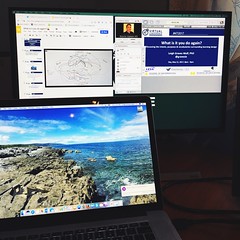
Behind the scenes view of the 4T Virtual Keynote

Yesterday I had the honor of presenting at the 2017 4T Virtual Conference. I am a tremendous fan of the conference and was honored that Liz Kolb and the 4T Virtual organizers asked me to be a keynote this year.  I HIGHLY recommend that you take a look through the sessions that were presented this year (and the archives!) It is a treasure trove of online professional development.

My keynote was titled: What is it you do again? Discussing the intents, purposes & vocabularies surrounding learning design.  The idea was prompted by a conversation I had recently with a colleague and in my talk I attempt to construct an argument for defining our work and remaining critical as we engage and define our profession as “learning designers” (or Educational Technologists, Instructional and Information Technology Manager, Program Support Specialists, Academic Specialists, Digital Coachs, Technology Guides, etc.)

I provided a virtual handout to go along with my talk which you can find here:
http://bit.ly/Wolf4Thandout

The recording of the session can be found here: http://bit.ly/4TWolf-Recording 
(requires Blackboard Collaborate) and the slides are embedded below.

In my session, I invited the audience to continue the collaboration and discussion – and I would like to do the same here. If you’re interested in collaborating on an article around this topic, please let me know!

Thanks again to all who attended, to my moderator Kevin Upton and to the 4T Virtual sponsors who make this incredible (FREE) event possible.


How I Listened: The Working Bibliography (Learning in Complex Domains)

I have tried to pinpoint the person or thing that made me Google while listening, but, I can’t quite put my finger on it. In the fall of 1997 (after quickly giving up on dreams of becoming a DJ) I started my career as “Technician I” at the International Academy. Google and the Internet as we know it now had just made a way into schools. (When I graduated in 1994 we had computer labs, floppy discs and Netscape navigator, but, Google (as we know) changed things.) In my role, I was not *just* a network administrator. I helped the faculty and students use the technology in their classes (we were not called “Tech Coaches” or “Learning Designers” back then!) Maybe it’s this early integration into educational experiences that led me to so much Googling when I started my PhD in 2004.

One of the earliest digital artifacts I have of this habit is a working bibliography I made while I was a student in Dr. Rand Spiro‘s CEP 957: Learning in Complex Domains. The class was a mixture of readings, lecture and discussion. When in lecture or discussing – if a resource/person was mentioned, I googled/looked them up in the library database and added to the document throughout the semester.

The file still exists in the original form here (long before google docs were a thing!)
https://www.msu.edu/~gravesle/complexbib.htm and I thought, 12 years on, that it may be time to modernize it and turn it into a google doc so I don’t lose it and so others can find it and contribute.  I often still reference it (as a matter of fact, that is what prompted this post!)

SO, if you’re looking for some resources on learning in complex domains – enjoy!

Click here to see the google doc (also embedded below) & add comments/suggestions.